olya
salimova
The shapes are stories. With their borrowed mouths,
the stories drink and feed and lick their wounds and do
their best to reproduce.
Robert Bringhurst, Life Poem

arrival
solo exhibition
Trinity Christian College, Palos Heights, IL
curator's exhibition essay:


arrival is an every traveler's dream, the stepping to the shore from a journey which is also a break, a drop-off from the stream bed to the ground level, or else that which is cut out by water. the waters of time we swim in are precarious and the land is at a great distance. consider Odysseus whose nostos is only possible when he retains his identity upon arrival by being recognized by the people (and one dog) he left behind. in the shifting waters of traveling through time geographically and intellectually the possibility of been re-accepted while finding a firm footing at one's home land is thinning in the air. arrival seems less and less attainable.
solace can be found in art making. consider the approach–arrival to a new form through a transformation.
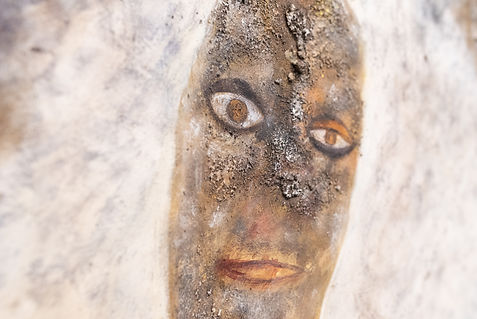
the figure changes in the artist's hands–moves from a three demential promptly made sculpture to a print, a collage, a painting and, finally, a talking spirit in the performance earth. it wants to attain a form that melds human will and the earth's abundant power to live, even if this form is transitory and suits only for the time being. but they are shapeshifters, aren't they, being and time?
arrival is also possible through fabulation. what if an alien race comes to Earth with a question, 'How does it feel to be earthlings?' this seemingly simple question makes me think of many potent things–the senses that accompany us, spirituality and poetics of the material of the natural world, the inner complexity of the self and its relation to the world around.


i want to enter a certain anomalous assemblage, to become a borderline between the human and the non-human. i am interested in a perpetual state of becoming, like G. Deleuze and F. Guattari propose in Memories of a Sorcerer. the becoming is a fluid, escaping state that i am chasing in attempt to fix it in place, give it substance, beef it up with material. it's like reading ancient epics – the heroes are evading but written down and made mythic.
the assemblage, or the becoming, is also a multiplicity. it dwells within us. in one of his masterpieces, H.P. Lovecraft recounts the story of Randolph Carter, who feels his "self reel and who experiences a fear worse
than that of annihilation: "Carters of forms both human and non-human, vertebrate and invertebrate, conscious and mindless, animal and vegetable. And more, there were Carters having nothing in common with earthly life, but moving outrageously amidst backgrounds of other planets and systems and galaxies and cosmic continua."
paraphrasing Deleuze and Guattari, the artist is a sorcerer, because art making is a becoming, an unnatural nuptial. "We know," Deleuze and Guattari say, "that many beings pass between a man and a woman; they come from different worlds, are borne on the wind, form rhizomes around roots; they cannot be understood in terms of production, only in terms of becoming."


transformation is at the core of the shifting and the uncentering, the diffracting light waves on the other side of the hole, a starfish cut up on many parts–these are the beginnings of many new wholes and
criss-crossings. this is why a sculpture is shattered to many images and a photograph spawns collages–the infinite process of birth, living and dying.


time is compressed in earthly materials like beeswax, soil and charcoal. these are ancient materials that humanity has been using to build, write, preserve, illuminate, bury, heal, protect, burn, craft, garden, nourish, fuel, ignite and fertilize. they are enunciating time capsules that talk about the labor of
the mankind and also of the bee, the worm, the plant. the communication which happens brings the artist to the origin of humanity, the source of creativity, the mother Earth. mother and matter might be the words of a single origin.


a mask is a tool to transcend oneself and become a spirit, a breathing word of another nature, an alliance. to ware a mask is to come to an anomalous position at the haunted fringes of the village, the fields or the woods. a mask is an enmeshment – a dreamed world and the lived one grow thick between the fingers.
sometimes a human face can become a mask – like when i
look at David Wojnarowicz’s Untitled (face in dirt), 1991. Wojnarowicz’s face is a mask in the state of both emergence and emergency like a growth on the skin of the earth, a gradual but inevitable and forceful formation. the mouth with its parted lips is both a receptacle and a vessel. it wants to speak but still is budding. the eyes don’t matter. the nose is a tubercle raising toward the sun, its function is reduced to growth.


roots, twigs and soil come from the garden, a creative arena for an art making that is bedded in the material and overflown with abundance. gardening stretches time
and keeps your fingers soiled with the awareness of worm-like minuscule but fertile existence.


sufficiently layered the materials and experiences form a time capsule, a foundation of memory, a propagation, an anlage. the bee produces and layers propolis to seal the hive off from wind, cold and predators. if a mouse makes her way into the hive she is stung to death by hundreds of bees and then swathed in the propolis,
sarcophagus-like, because, like limestone used by the ancients for making coffins, the propolis is a "flesh-eater" that decomposes the body of the mouse quickly. this is the way i like to think about it. this preservation of the flesh is also a preservation of time, a generative and abundant process.


all photographs by Lillian Heredia